Thursday, June 25, 2015

I've got two bars: Putting the solar panel above the bimini

George and Sterling add hardware to the bimini in preparation for two new stainless bars.
I liked having the solar panel on the stern pulpit because it was out of the way, but it interfered with using the swim platform and made the crew less safe. I had my sailmaker add reinforced holes in the bimini cloth and hardware to the structure so that two 6-foot stainless bars could be stretched across the frame. I placed the panel atop these bars using the same quick-release plastic clamps that I have been using.

Solar is so inexpensive and easy to add that all boaters should consider adding a panel to their vessel. 

Monday, June 8, 2015

Waiting It Out


Much of a charter captain's life is spent waiting for weather to come and go. Weather is not usually a surprise because we have great systems to predict the weather and watch it move on our computers and mobile devices. Currently, I'm waiting for a fast-moving storm to pass through. After it passes, I expect nice weather in which to sail. 

I hope the weather is nice because I'm taking a father and daughter sailing. I know the father wants this to go well for her. So do I. I imagine that he has dreamed of the comradary he will develop with his family through sailing. Of course, he probably hasn't imagined heavy rain, wind, hail, and lightening. 

I hope the weather is nice. 


Thursday, May 14, 2015

Hull Bottom Sins

We've been bad to Speakeasy over the years. We being my yard and me. Also our Chicago weather. First, Speakeasy's cradle is made to Catalina Yachts specifications and she's been resting on this cradle each off-season since 1999. It turns out that we've added stress to the hull by positioning the cradle so that the carpet-covered pad was not directly beneath a bulkhead on the aft port quarter. Very cold weather and age made the gelcoat brittle so that it cracked. Poor cradle support added to the problem. 
Cracks in the gelcoat above and below the waterline on Speakeasy. 
The repair required the gelcoat, coremat sublayer, and some fiberglass to be cut away and built back up. In the photo below, material has already be applied to the hollowed-out section and fairing compound applied.
Speakeasy bottom near the port quarter after grinding and fairing. 
The next image shows the completed project. The white and blue (for the water stripe) gelcoat was applied to bring the repaired section to the same thickness as the original. Then, it was polished with cleaning compound. Once the bottom paint is applied, it will be better than new.
The finished repair before the addition of bottom paint. 

Wednesday, April 29, 2015

Clean and Green Boating


Mark Gillingham (Columbia Yacht Club Cruisers Fleet member, SPLASH Great Lakes) and Kim Kreiling (Illinois Department of Natural Resources)

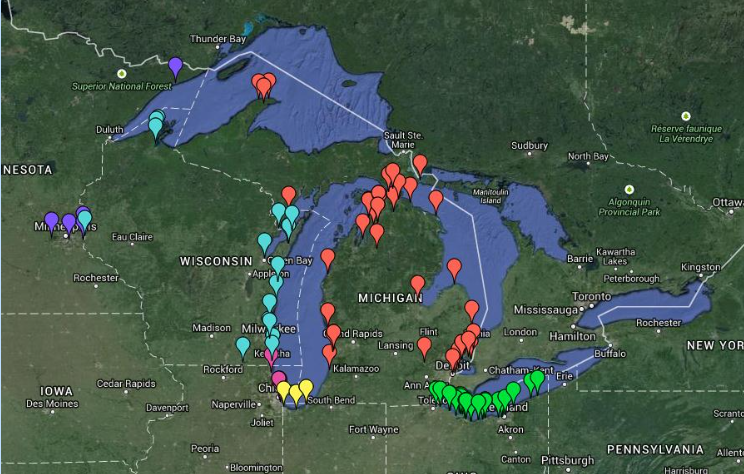
On Saturday, April 25, 2015 the Columbia Yacht Club Cruising Fleet sponsored a seminar on keeping our marinas and surrounding water clean (slides from the seminar). We had a special guest from the Illinois Department of Natural Resources, Kim Kreiling, who is the director of the Clean Marinas program in Illinois. The Clean Marinas program exists throughout the Great Lakes Region 5 (see the map of Great Lakes Clean Marinas).

Screen Shot 2015-04-21 at 10.53.40 AM.png
Each pin represents a certified clean marina. Colors distinguish states. All of Chicago marinas are certified or are in the process of being certified including the Columbia Yacht Club. 


Bottom washing, especially using a power sprayer releases heavy metals, which do not degrade quickly or easily and can accumulate in the food chain. Some states require marinas to have a special permit to wash boat bottoms, but Illinois is not one of them. See these slides from the Wisconsin Sea Grant for more details. 

A clean and shiny boat is easier to keep clean. Wash with nontoxic cleaners and use as little as possible throughout the boating season. A pail of water and a soft brush can remove most particles. Use a hand spray bottle filled with a mild soap solution for tougher dirt and stains. Deeper stains can be removed from fiberglass with a paste of baking soda and water. This fiberglass stain remover has other uses too. I used this stain remover on a faux stone countertop with great results. When a disinfectant is needed (e.g., the head), use a solution of borax and water (1/4c borax in a gallon of water). For nasty mildew, make a paste of lemon juice (or white vinegar) and salt. Rub the paste on the stain and flush with water.
Common household products can become your standard go-to boat cleaning and polishing agents. Recipes for brass, fiberglass, aluminum, and other surfaces are available from the Clean Marinas site (see text).
Nontoxic cleaning products are available from the Columbia Yacht Club store. 
Polishes are also be made from common products. Olive or almond oil can be used to keep interior wood polished bright. Chrome can be cleaned with apple cider vinegar and polished with baby or mineral oil.
A DIY brass cleaner consisting of salt, vinegar, water and 5-minutes of brushing with a soft toothbrush made a huge difference in the shine of the 60-year-old gimbaled candlestick on the right.

Saturday, January 31, 2015

It Is Really Grand: The Grand Canyon

When we reach the South Rim of the Grand Canyon, the fog was so thick we couldn't see the path. We walked along the path gingerly so we wouldn't take a wrong turn and hoped that the fog would lift in a few minutes. After an hour, we decided to get a camp site and try our luck in the morning. Once we registered our site, we went back to the rim where the fog had lifted enough so that we could see the bottom of the canyon. The fog looked like icing on a very large layer cake. 


Beth has a big smile when the fog lifts and the canyon comes into view. 

Shadows and fog over the Grand Canyon. 

Java meets new friends at the South Rim. 

Wednesday, January 28, 2015

Oracle, Arizona

Sunrise in Oracle AZ
I'm sitting on the south-facing veranda of our friends' casita in Oracle, Arizona watching the sun rise over the small orchard in the yard. The sky is a bright orange after a star-lit night. And such stars as I've never seen. The air is clear and clean and we are far from the city lights of Phoenix and Tucson. In fact Oracle is designated as a dark sky site by Dark Sky International.

On the veranda the sun is up and burning away the chill of the night. Java is basking in the sun on stones that are beating quickly. Soon, Beth and I have moved our chairs to the sun and are also basking. Java oscillated from warm stones in the sun to cool ones further away and back again. She knows how to live. I'm starting to get the hang of it. 

The casita was once a chicken coop that the gardener converted to a grand bedroom. That shed was extended to create a companion room for sitting and dining. It's a lovely space created with many local and homey touches fitting for the area. 

Friday, January 23, 2015

Santa Barbara in January

Santa Barbara has blooming flowers in January! It's hard for me to get my head around that fact. I'm used to frozen ground covered with snow. The only gardening is some pruning once a short thaw has reduced the snow cover a bit. 


Beth and Java got to play at the beach near UCSB. 


During a wine tour near Stearns Pier in Santa Barbara, we saw an Oscar Meyer Weiner Mobile—an unlikely sight, I would have thought. I lived for a time in the 80s near an Oscar Meyer facility at which an older Weiner Mobile was parked. Back then, I saw it regularly. 


The mission in Solvang, which got its mission bell in a second wave of missions. The Mexican government secularized it and eventually the ranch it was on was sold to Danes. The Danes created a folk school. Now it is a tourist village with a Danish-wine motif. 


We did sample some of the Santa Barbara County wine. 

Monday, January 19, 2015

The RV Life


We are sitting at the Mission Bay RV Resort in San Diego cleaning the mini-motor home that my generous brother loaned us to try out the RV life. We pushed from Chicago across the southern plains to get to better weather—we have it now. The temperature is mid to upper 60s with a few lazy clouds. The routine includes walking Java along the Bay, making coffee, and preparing for the day. We don't have far to go today, just to the other side of town where we are meeting our cross-street neighbors from Chicago who have taken an apartment in San Diego. Tomorrow we get to sail with them.

I met a women in the laundry room who said they had been here a week and are moving on to Riverside where there is a nice park. She's a full-timer and only stays a few days at any spot. Next for her is Lake Perris State Recreaction Area near Riverside, CA. We have not not found our perfect campsite or RV park yet. Campsites usually offer scenic beauty and natural recreation like hiking. RV parks are similar to motels near cities or attractions. In the oil-producing states, RV parks are filled with working men. In LA, filled with movie-industry workers. We've come to rely on AAA and Google reviews of sites to judge appearance and cleanliness. It's an art to read a review and get the correct image of a place. 


Tuesday, December 30, 2014

Meters That Use Light Versus Meters That Use Electrodes

I'm just beginning to understand the differences between meters that measure pH, turbidity, dissolved oxygen, and other components of water. The traditional meter measures light or color. For instance in the Secchi scale, one drops a disk in the water until it just fades from view. What is measured is the length of line played out. The Secchi disk is easy to use by volunteers to monitor inland lakes  (e.g., Indiana Clean Lakes Program, and Citizen Lake Monitoring Program in Minnesota). A modification of that principle is used in the World Water Monitoring Challenge Test Kit in which the distance is controlled by the depth of the container and the clarity of the water is compared to a standard chart. Charts are also used in the Kit for color comparisons when color-activating chemicals are added.
Modified Secchi Scale controls the depth and compares the clarity of the disc on the right to a standard shown on the card to the left. 

Color spectrometry is used to calculate the pH value. The chart on the left is compared to the chemical-filled water sample on the right. 
Although the naked eye can do a good job of comparing standards to samples, there is error introduced from the light source and the human eye. Spectrometers are more accurate. Chemicals are available to colorize for many molecules contained in water (or soil). For instance, Phosphate and Nitrate amounts can be detected using appropriate chemicals and a spectrometer. An example of a spectrometer used to measure swimming pool water is the eXact iDip.

An alternative to measuring color through spectrometry is to measure electrical conductivity with a galvanometer and electrodes. Doing so requires specific electrodes and calculations, but not added chemicals. A simple device is the total dissolved solids meter (e.g., Dr. Meter TDS conductivity meter). To learn more, read about ion selective electrodes on Wikipedia. One advantage of using electrodes is the elimination of chemicals and color analysis. Another advantage is automation. For instance, an electrode-based probe can be connected to a smartphone to read, geolocate, calculated, store, and transmit automatically. For instance, Sensorex makes a general smartphone interface for its probes and pH interface for iPhone (approximately $300). YSI has an interesting multi-electrode product that is portable [Meter ($1500), assembly ($1700), and sensors ($450-$1000].
Sensorex iPhone adaptor and probe.


Tuesday, December 23, 2014

A Lake Michigan Cruiser Takes to the Land

Beth and I have been cruising on Lake Michigan for 8 seasons and have put about 8,000 miles on Speakeasy, mostly going from Chicago to Beaver Island, Michigan. In October, we got the chance to try a small motorhome for a weekend and since then have been to Bay Field on Lake Superior, Lake Winnebago, both in Wisconsin, Traverse Bay in Michigan, and Lake Eloise, where Cypress Gardens used to be in Florida. In a few months, we've traveled 4,000 miles. Our next land-cruising trip will be to Los Angeles via the great Southwest United States—another 4,000 miles. We'll have put as many miles on VERA in 6 months as we have on Speakeasy in 8 years.
Beth, Mark, and Java before VERA in Winter Haven, FL

We're so lucky that I have a generous brother who is willing to travel vicariously while he waits for more time off. It's his family's motorhome. The van is a Dodge Sprinter conversion by Winnebago. At 24-feet long, it is a perfect size for a couple with a dog. Like Speakeasy, it has a large berth for sleeping, comfortable salon seats, a salon table, galley, head, and fresh water. In addition, VERA has both heating and air conditioning. We're still learning about the land cruising world, but will share more along the way. 

Lakewood RV Resort in Hendersonville, NC is near Flat Rock where Carl Sandburg lived the last 2 decades of his life. 

Fort Clinch State Park on Amelia Island, FL is a wonderful beach park. 

At the old train station with old friend on Amelia Island, FL

Sunday, October 26, 2014

Cruising Down the River

Each fall our crew takes Speakeasy from its mooring in Monroe Harbor, through the Chicago Lock, and down the Chicago River to Canal Street Marina. This fall we had a beautiful day—sunny and warm. I was greeted by a sunrise while on the tender to pick up Speakeasy at her mooring in Monroe Harbor. Tender Captain Mayre bid me a safe trip and pleasant off season as I stepped onto Speakeasy's deck. 

Twenty minutes later, I had the mooring bridal and ball (can) cover aboard the swim platform and was headed to the pier at Columbia Yacht Club. After a quick wash of the cover, I began taking down the foresail when my crew arrived to assist. It was 8 am and we were scheduled to cross beneath the Lake Shore Drive lift bridge at 9, but first, we had to enter the Chicago Lock. The Lock divides the Lake Michigan-Huron basin from the Chicago River and, ultimately, the Mississippi River. 

Sunrise on the increasingly empty Monroe Harbor.

The river has amazing views of Chicago architecture including Jeanne Gang's Aqua building [http://en.m.wikipedia.org/wiki/Aqua_(skyscraper)]—the first skyscraper to have balconies that are safe for residents from wind gusts. 

Skyscrapers along the Chicago River including one designed by Jeanne Gang in the background. 

A new feature of the river cruise this season was a barge that partially sank in the middle of the South Branch. During our trip, salvage barges were on either side of the troubled barge. Boat traffic had to line up single file to pass near the east bank. 

Barges on the South Branch, one of them sunken.  
Helper barge on South Branch. 

Broken and sunken barge on South Branch. 

The last sloop around the barges on the South Branch.


Speakeasy was first in line at Canal Street Marina to be hauled out. Straps were place beneath her to hoist her up out of the river and over to land. Once overs land, Speakwasy was power washed and set on a trailer. 

Speakeasy getting a wash down at the Canal Street Marina. 

The trailer was pushed into place near other boats for the winter. Shortly thereafter, I prepared her for a cold winter by changing oil, conditioning fuel, and winterizing the engine and water systems. 

Speakeasy's winter resting place at Canal Street Marina. 

Wednesday, October 22, 2014

World Water Monitoring Challenge in Northern Lakes

Boat launch at High Cliff State Park on Lake Winnebago, Wisconsin. 
I have had the World Water Monitoring Kit for a few weeks now and have collected water samples from my local harbor in Chicago and three lakes in Wisconsin including a very small (Clear) and very large lake (Superior). The activity is fun and gives me the opportunity to talk about the local water and how temperature, turbidity, pH, and dissolved oxygen affect water quality. I keep my data in the kit's notebook and transfer it to the World Water Monitoring Challenge database and a spreadsheet that I keep. In general, the northern lakes are a little more acidic and less turbid than our local harbor on Lake Michigan in Chicago (see Chart).

Chart 1: World Water Monitoring Challenge Data Collection


The Lakes

Clear Lake in Hayward Wisconsin

Clear Lake near Hayward, Wisconsin. 
Clear Lake is part of the Spider Lake chain of lakes near Hayward in northern Wisconsin. In the late 19th century, Hayward was a lumber area where camps of lumberjacks lived and worked at cutting and removing trees from the forest. Once the best trees were cut, which took only about a decade, the land was sold to immigrants as farmland, abandoned (some of which was transformed into the Chequamegon National Forest), or transformed into vacation resorts and homes for urban dwellers. Today, Clear Lake has a couple dozen personal dwellings, a golf course, and a boys camp on its shore. 
A cut area where previously a forest stood. Photo at the Northern Great Lakes Visitor Center in Ashland, Wisconsin. 

Clear Lake is a small shallow lake near Hayward Wisconsin. A water sample was taken close to shore near the deepest part of the lake—about 6 meters. 


Lake Superior at Bayfield, WI

Sunrise over Madeline Island from the Dalrymple Campground in
Bayfield, Wisconsin. 
Dalrymple Park Campground is operated by the city of Bayfield, Winsconsin and located just north of the city. Campsites are available for rustic packing in or plugging in recreational vehicles. All sites are near Lake Superior and the Apostle Islands.
Dalrymple Campground, Bayfield Wisconsin is on Lake Superior with a view of Madeline Island.
A water sample was taken from the shore of the campground.

Lake Winnebago at High Cliff State Park in Wisconsin

The cliff above Lake Winnebago shows a crevice
a few meters from its face. 
High Cliff State Park was created from an abandoned lime kiln that had been in operation from the 19th century to its closing in 1956. High Cliff (a.k.a., Clifton) was named after the limestone cliff, a prominent feature in the northwest corner of Lake Winnebago. The park features camping, hiking, swimming and other water sports including a marina. 

The marina at High Cliff State Park is on Lake Winnebago, which is part of the Fox River watershed and home to ancient sturgeon. A water sample was taken from the end of the boat launch ramp. 


Wednesday, October 15, 2014

Sailing the Dalmatian Coast of Croatia

The guys were talking enthusiastically about the 53-foot-long sloop that Peter had chartered. It had everything—four rooms each with its own head, duel helms, and electric winches. "It even has bow thrusters," Peter shouted over the traffic noise. "Bowel thrusters! What's that?" asked Jill from the furthest seat back. Immediately, everyone broke into wild laughter and did again several times per day for the next week as we imagined what "bowel thrusters" might be.

Thus began our magical week sailing along the coast and islands of the Dalmatian Coast of Croatia.

Vis Luka (harbor). Views like this one was why we came to the Dalmatian Coast of Croatia. 
In early September, 2014, a group of three couples sailed a Jeanneau 53 named Trinity to the islands of the Dalmatian Coast of Croatia. We flew to Split and sailed out of Marina Kremic. One of the crew, Peter, had sailed the Dalmatian Coast previously and chartered our sloop for us, which made the trip very easy. Beth and I flew from Chicago to Geneva through Zurich to meet the rest of the crew before we flew to Split. Our sailing itinerary took us from Kremik to Primosten, Maslinica, Vis City, Budakovac (also off of Vis), Palmizana, and Necujem. We also toured via taxi the UNESCO Hertitage Sites of Trogir and Diacletian's Palace in Split.


Captain's Log from September 6 to September 12, 2014

Itinerary 

Saturday: Our group flew from Geneva to Split on EasyJet and took a taxi to Marina Kremik where we met our Jeanneau 53 sloop, which we sailed a short distance to Primosten to spend the night swinging on a mooring ball and enjoying the ancient city.

Trinty had plenty of room, two wheels, electric winches, thrusters, solar panels, four state rooms, and four heads. 

The peninsula of Primosten was a beautiful introduction to Dalmatia. We dine on fresh fish and walked to the church at the top of the hill.

Sunday: From Primosten, we had a leisurely day in light wind to the beautiful harbor of Maslinica on the island of Solta. We arrived at rush hour in the late afternoon. Boats were lined up for 3 hours backing into the quay. Only one of our crew had every moored in this manner before and it showed. Other crew made it look so easy.

The view from Tinity's cockpit while moored in Maslinica. 

Nearly all of these boats and many others arrived in the late afternoon at Maslinica, our introduction to Med Mooring. 

Each harbor had fresh food and lovely surroundings and views. This restaurant in Maslinica was named after bats: Sakajet. 


Monday: From Maslinica, we sailed to the large and ancient port of Vis where we picked up a mooring ball near a popular restaurant. We didn't realize the wonderful antiquities we would see in Vis Grad.

The 16th Century Church of St. Jerome was built from the remains of a Roman theater on a small peninsula in Vis harbor. 

Beth takes pictures of the beautiful harbor in Vis. 

Beth met a biking nun at the door of the 16th Century Palace Gariboldi in Vis. 

16th Century Church of Our Lady of Spilice in Vis. 
Tuesday: From Vis harbor, we sailed around the island to the Blue Caves and then further around to Budakovac where we picked up another mooring ball. We took the dinghy into the cave to see the amazing blue light reflecting up from beneath the surface. Budakovac was both beautiful and rustic and became a favorite spot.


Sunset at Budakovac, one of our favorite spots. 


Beth relaxes in Trinity's cockpit at Budakovac. 


Wednesday: We sailed north to the island of St. Klement off the big island of Hvar to Palmazana harbor. St. Klement has many small inlets surrounding the island where boats may anchor alone, but the larger Palmazana harbor features restaurants and resorts, which we didn't want to miss.

Signs for three restaurants near Palmazana. 
Beth at the helm leaving Palmazana. 


Thursday: We left Palmazana in unstable weather and had to duck into the large anchorage of Necujem at the end of the day. We waited out a squall and scouted good anchor ground before putting down our anchor in a picturesque spot. The weather cleared just before sunset. Two of us rowed the dinghy to a taverna for their special risotto and brought it back to the hungry crew. We never tasted such good risotto. In the morning, we saw a Dalmatian riding in the bow of a dinghy. A good omen, we thought.

Everyone read.
We had plenty of time to read. 

A Dalmatian rides the bow of a dinghy past Trinity and our cameras. A good omen, we thought as we prepared to leave Necujem for our home port, Kremic. 

Friday: From Necujem, we motor-sailed to our home port of Kremik where we got fuel and prepared to check in the next morning. In the late afternoon, we took a taxi to Trogir, a UNESCO World Heritage Site.

In Marina Kremik, the line for the fuel dock was an hour. We were glad to have thrusters against the growing breeze. 

A short taxi ride took us to the walls of Trogir and another fine dinner, this time in the pouring rain. 
One of the hotels along the quay in Trogir. 


Saturday: We checked Trinity into the charter company and took a taxi to Split to see Diocletian's Palace, which is a UNESCO World Heritage Site. Later that afternoon, we left Split for Geneva

Beth hams it up with the Roman actors in Diocletian's Palace, Split.  

Church at Diocletian's Palace, Split. 

Hotel on the quay in Split. 


Beth tries out her Croatian on the clerk at the fruit stand in Split. 
The islands near Split on the Dalmatian Coast, Croatia.