Tuesday, September 23, 2014

Driving a Water Cab

Cab drivers are ubiquitous. They come from around the world and each has a story. Some are willing to tell theirs. For instance, on a sub-zero night in Madison, WI, a drive with a PHD in physics came into a dark bar to retrieve us so we needn't huddle outside in the cold. Drivers work hard as documented by the driver from Bangladesh who had saved enough to buy a second cab medallion at a tens-of-thousands-of-dollars each.

I recently signed-up to be one of the drivers for the tender service at Monroe Harbor in Chicago. During my 4 days of training I got to know the other drivers. Each had a rich story of how they got to be cab drivers on the water. Retirement or summer work were only part of their stories. The drivers had rich and varied backgrounds. Some were poets, actors, engineers, fathers, beach bums, educators, and philosophers. A great environment in which to tell stories between rides. 

Tuesday, September 2, 2014

Solar Panel On Stern Pulpit

Photovoltaic Panel On Stern Pulpit
PV panel hung on the stern pulpit of Speakeasy.

After stringing wire and installing the controller and battery monitor, I thought installing the photovoltaic (PV, solar) panel would be a breeze. This has not been the case at all. My first mistake was thinking that a single bar would support the panel, which is over 30 pounds and it's dimensions are nearly 3' by 5'. I had Sterling (Sterling Sails) create a bar made of 1" stainless steel that spanned the aft Bimini from starboard to port. Brian, our club's dock master, and I attached the panel to this bar and judged it "too floppy" to be trusted in wind and waves. We removed the panel and stowed it in the salon for a month while we sailed around Lake Michigan. 

While out on the Lake, I saw a few PV panels affixed to Bimini stanchions and in all cases two bars were used. I needed to go back to Sterling. I also did some web browsing and noticed that a New Zealand sailor kept his panel on his side rail, which allowed him to bring the panel in close during poor weather and to angle the panel toward the sun during better conditions. I also saw this arrangement on a sloop in Marina Kremic, Croatia. This got me thinking about placing the panel on the stern pulpit, which is the only rail wide enough to hold the 5' long panel.
I saw PV panels on a boat in Croatia similar to this setup.


The benefits of having the panel lower is that it catches less wind and can be removed more easily than atop the Bimini. The issues include access to the ladder and swim platform, which is a matter of safety. Borrowing from the New Zealand sailor! I added two quick-release plastic hangers near the side of the panel and began to fashion an angle adjuster made from a marine antennae adjuster affixed to a vertical bar made of PVC similar to the one the New Zealander made.  I also attached two sail ties from the bimini structure above the panel secured to the Bimini structure. These two points of contact seemed to add more support than the single bar made from the PVC and antennae adjuster. 

When the panel is parallel to the water, the ladder can be raised and lowered and one can duck under the panel to reach the swim platform. This is a good solution when we leave the boat unattended for days or weeks. However, when actively sailing, I'd rather have the panel out of the way above the Bimini. So, Sterling will have to add another bar up top.
Typical PV panel hung on davits.
Each PV panel is hung from a single rigid bar.

Wednesday, August 27, 2014

What if Water Quality Testing Were Easier?

Although we are very dependent on abundant clean water, we only test the quality of our water in a relatively few places and few times. Mostly, we rely on local and national government agencies (e.g., water treatment facilities, EPA). Hach of Boulder Colorado realized that if testing were easier and could be done in less time, more tests would be taken. That's why Hach's new water tester is a big win for clean water.

Take a look at Hach's video portraying the old (30 minutes) and new (8 minutes) way to test water.

Sometime in the near future, citizen scientists will be able to take high-quality measurements of nearby water sources and provide this data to a global database. We will know quickly where the hot spots are and be able to take action before pollution is out of control.

Tuesday, August 12, 2014

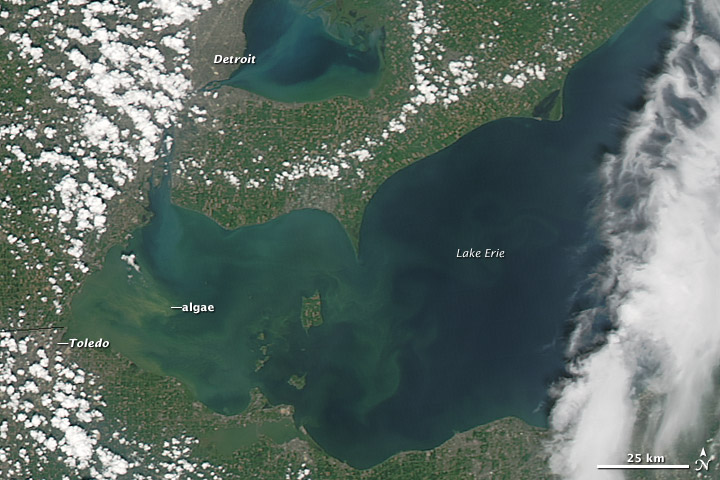
It's not just Lake Erie that's dying.

Image from NOAA, August 3, 2014
What's being done to protect Lake Erie from Phosphorus runoff? Nothing official although some individual farmers set aside about 3% of their land to create a runoff buffer. The rights of the millions who drink Lake Erie water are pitted against the rights of landowners to do what they wish. Actually, what most farmer's wish is that the nutrients would stay on their land and not run off, but preventing runoff has different solutions and different properties and always involves costs. The consequence of this laissez faire policy is a nearly dead Lake Erie along with hundreds of smaller lakes throughout the Country. 

In the 1970s detergent manufacturers were compelled to remove phosphorus from their products, which over a decade brought Lake Erie back to health. Since then, however, the runoff from unregulated farms has driven the lake back to the brink. 

Jeff Reutter, Ohio Sea Grant and Stone Laboratory

"Flooded by tides of phosphorus washed from fertilized farms, cattle feedlots and leaky septic systems, the most intensely developed of the Great Lakes is increasingly being choked each summer by thick mats of algae, much of it poisonous." For more information read Behind Toledo's Water Crisis. 

Ohio Sea Grant recommends that each contributor reduce their phosphorus output by 40%. This would have a similar effect to that of removing phosphorus from detergent and bring Lake Erie back to life and protect drinking water and the lake's ecosystem. 

Pollution concerns persist about tides of phosphorus in the Great Lakes and in waterways across the United States.

Tuesday, August 5, 2014

Port Washington Power

Port Washington Light (right-center) and Generating Station (far left). 
Port Washington Generating Station
is an intermediate-load, natural gas-fired, electrical power station located on Lake Michigan in Port Washington, Wisconsin. The natural gas facility replaced an older coal-fired station in the early 2000s. In time, this plant may be retired or converted once again to an even less polluting source of power. 


Initially constructed during the depression (1930-1935) to supply power to the growing needs of Milwaukee. It burned pulverized coal until 2000 when it was shut and converted to natural gas. Two turbines are online (2003 and 2005). These turbines produces as much CO2 each day as 50-thousand people

Monday, August 4, 2014

The Long Curve


We usually think of going from point A to point B in a Cartesian manner: a straight line. Sailboats are not so linear even with all of their electronic navigation gear. As Beth and I set out for Washington  Island, WI from Beaver Island, MI we'd hoped for a Southeast wind and a beam reach. What we got was wind that was slightly west of south, which put Speakeasy on a very close haul, which it does poorly and with our regret due to the uncomfortable ride.

I determined from a wind map based on NOAA data that the wind would become more southerly as the day wore on so after a conference with the sleepy crew, we decided to set the auto helm to 30 degrees apparent and let the boat follow the changing wind. When locked into the wind rather than a compass point, the auto helm keeps the boat pointed toward a particular angle to the wind direction. If the wind did not change for the better, we would end up on the shore of the Garden Peninsula rather than Rock Island and Washington Island, which are south of it. 

Fortunately, NOAA had predicted the wind shift accurately and our track followed this bow curve toward our intended destination. In the following image, the blue triangle represents Speakeasy current location and direction. The grey dashed lines behind the triangle represent the actual locations in the past. Notice that this dashed line has curved toward the southwest as NOAA predicted.

Thursday, July 31, 2014

Going Home

We've been aboard Speakeasy for 30 days and look forward to sleeping in our "big" bed tonight. Java seems happy enough, but she may be happier in her cot at home too. Sampling the hedonistic pleasures of the Lake shore in Michigan and Wisconsin has been a fun adventure. We can't see a beautiful sunset in Michigan without ice cream (Beth's favorite is French Silk) and Java can't go by a boat ramp without walking down into the water followed by a fast run around. We thoroughly enjoyed our month-long sail.
The Lake is also an historical marker of what has been before from large pleasure liners ferrying tourist from Chicago and Milwaukee to lighthouses and power generation plants. The latter make use of the cold water for cooling and water shipping lanes for coal. Some of the coal plants have been converted to gas (e.g., Port Washington) or nuclear (Zion) years ago. I can imagine how things used to be and see how they are. In the future, we will need to take more care of our Lake to remove the corrosive effects of algae blooms and toxic chemicals. After all, the Lake is our fresh water source as well as a source of great pleasure.